
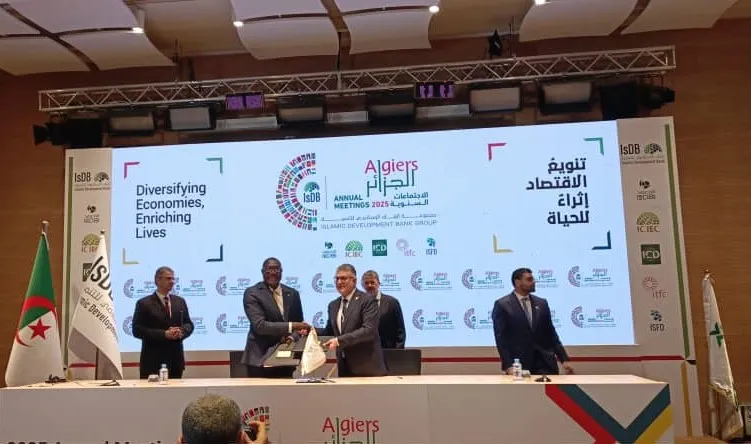
Amid a major move to strengthen trade flows and economic resilience in West Africa, International Islamic Trade Finance Corporation (ITFC), a member of the Islamic Development Bank (ISDB) group, has partnered with ECOWAS Bank's Investment Development Bank (EBID), to launch a $100 million syndicated trade lending facility. The agreement was signed on May 21, 2025 at the 50th ISDB Group's annual meeting in Algiers and identifies crucial steps to deepen economic integration across the ECOWAS region.
The facility aims to unlock funding for critical trade activities and provide access to essential goods, capital and services to local businesses and governments of ECOWAS Member States. By easing liquidity constraints and enabling competitive participation in global markets, the initiative is poised to strengthen commerce within Africa while supporting the broader sustainable development goals.
The agreement was formalized at a ceremony attended by senior officials from both agencies. ITFC is CEO Eng. Adeeb Yousuf al-aama was represented by Ebid on behalf of Dr. Andrews Amankwah, Director of Treasury and Resource Mobilization, on behalf of Dr. George Agyekum Donkor, Chairman of the Board of Directors.
Increased strategic funding for ECOWAS
The newly signed facility reflects EBID's strategic mission to provide financial support to accelerate socioeconomic change in West Africa. As a development financial institution for the Economic Communities of West African States (ECOWAS), EBID plays an important role in regional integration, trade promotion, and funding sustainable development projects. This latest partnership with ITFC represents a deeper commitment to the agency to deliver tangible and large-scale outcomes across a 15-person regional bloc.
Funds mobilized under the facility are led to trade-related sectors with high economic impacts, such as energy, agriculture, manufacturing and basic commodities. As trade is a key engine of growth in the ECOWAS region, improved access to finance is expected to promote production, create jobs and raise the standard of living for millions of West Africa.
Dr. Amankwa emphasized that the partnership emphasizes Evid's enduring focus on ensuring financial inclusion and economic empowerment. “These contracts are beyond numbers. Empowering businesses and communities by unlocking the resources they need to grow and thrive. It's building a more thriving, integrated and competitive West Africa,” he said.
Filling the trade finance gap
According to the African Development Bank, trade finance is a continuing challenge across Africa, with an estimated annual gap of over $81 billion. Small and medium-sized enterprises (small and medium-sized enterprises) that make up the backbone of many African economies often face serious challenges when accessing affordable funding. These constraints hamper the ability to expand to cross-border trade and integrate into regional and global value chains.
ITFC was established in 2008 with a mission to advance trade between Islamic Cooperation Organizations (OIC) members, but it consistently seeks to address these challenges by providing coordinated financial solutions. Its trade finance products bridge the liquidity shortage, reduce risk and help countries and businesses engage in essential imports and exports.
The strategic alliance between companies and EBID is built on a series of successful collaborations across Africa and is consistent with a broad commitment to promoting inclusive and sustainable trade. Over the past decade, ITFC has approved cumulative funding of over $66 billion, with West Africa receiving a significant portion of its investment.
According to Eng. Al-Aama, the current contract represents ITFC's efforts to form an impactful partnership that delivers transformative outcomes. “We are proud to be able to work with EBID to support the economic development of our region and to enhance competitiveness in ECOWAS countries. The facility is a practical demonstration of trade-driven growth and shared commitment to financial cooperation,” he said.
Drive competitiveness through strategic partnerships
The timing of the contract is especially important. As Africa moves to operate the African Continental Free Trade Area (AFCFTA), there is growing demand for regional financing mechanisms that support trade facilitation, infrastructure development and industrialization. The ITFC-EBID Partnership directly addresses these needs and provides a scalable funding platform that helps ECOWAS countries align their trade policies with continental integration goals.
Furthermore, the facility underscores the importance of multilateral cooperation in achieving shared development goals. By pooling resources, technical expertise and risk sharing frameworks, institutions such as ITFC and EBID can unlock more capital and provide projects that have a wide range of developmental impacts.
Analysts note that such collaborations are essential to ensuring Africa's recovery from recent global shocks, including the Covid-19 pandemic, climate change and supply chain disruptions associated with geopolitical instability. As trade finance emerges as a key lever for resilience, this latest transaction serves as a model for how regional and international development finance institutions can co-create solutions to complex challenges.
Promote inclusive growth and prosperity
At the heart of the initiative is broader ambitions. It is to ensure that trade will become a driver of inclusive and sustainable development. For millions of people across the ECOWAS region, greater access to goods, markets and economic opportunities means the difference between poverty and prosperity.
In this context, a $100 million facility is not just a financial contract, but a means of social impact. By helping the country import essential products such as food, energy and medicines, and enabling SMEs to expand their operations, the partnership directly contributes to improving livelihoods, strengthening food security and fostering entrepreneurship.
It also complements Ebid's long-term development priorities, including supporting young and women-led businesses, investing in climate-resistant infrastructure, and advances in local value chains. By integrating these priorities into trade finance, both institutions ensure that economic growth leads to true benefits for ordinary citizens.
Future view: Scaling the impact of innovation
As ITFC-EBID facilities are ongoing, both partners look forward to future opportunities to expand their impact. There is already debate about expanding similar trade finance mechanisms to other parts of Africa, using innovative instruments such as Islamic finance and financing to attract wider participation from private investors.
Furthermore, digitalization is expected to play an increasingly important role in enhancing efficiency, transparency and reach of trade finance operations. Both ITFC and EBID have expressed interest in researching FinTech solutions that streamline credit valuations, reduce transaction costs, and allow for rapid spending, especially in underserved segments.
Ultimately, the success of this partnership is measured by its ability to catalyze actual economic change on the ground. For West Africa, where demand for employment, infrastructure and capital continues to grow, ITFC-EBID trading provides a timely and hopeful signal. With proper partnerships, trade can become a powerful engine for shared prosperity.
