
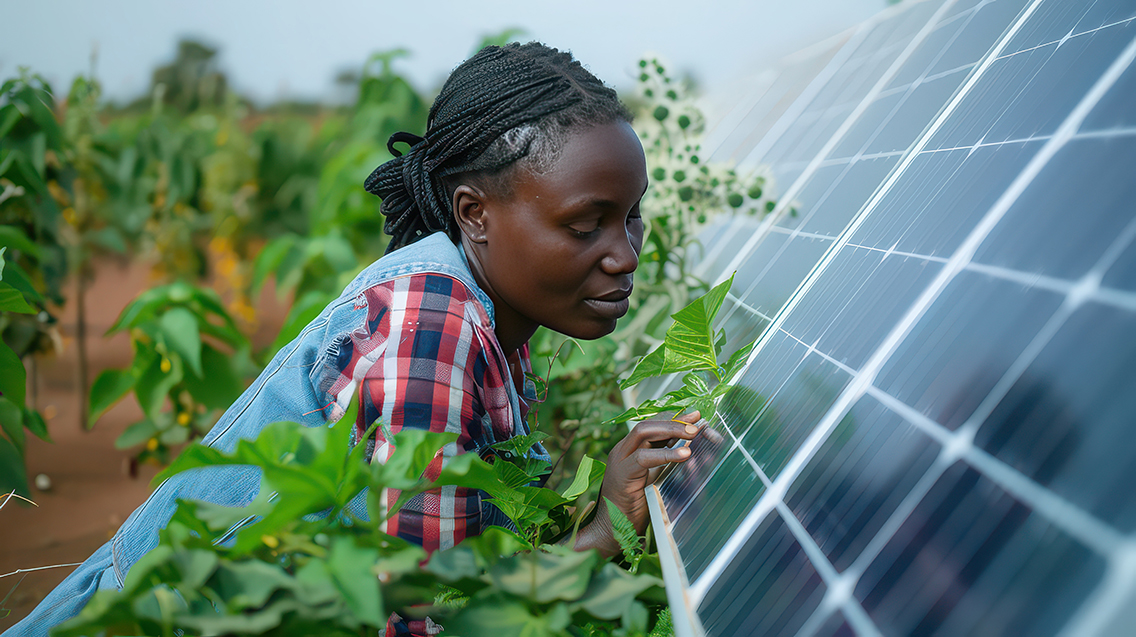
With over 600 million people in Africa unable to access energy, the continent is facing a sharp energy deficit. As the continent is tackling this challenge, experts believe that women must be fully involved as there are certain effects that women face as a result of energy access. To mark Pan Africa Women's Day that fell on July 31, African businesses convened a panel of all women experts to discuss the roles women can play in addressing African energy challenges in the latest in the Energy Series. The discussion was hosted by Yvonne Okwara, a senior news anchor and editor responsible for research and planning on Kenya's broadcasting station and citizen TV.
Opening the discussion, Dr. Amani Abou Zaid, former commissioner of infrastructure energy in the African Union, noted that lack of energy access is being charged to the continent between 2-6% of GDP and that it needs to be addressed urgently. The statistics are even more disastrous in clean cooking, with over 90% of the population not accessible. “Of the 1.3 billion people, nearly 1 billion people do not lack access to clean food. This has impacted their health and is one of the main causes of preterm births on the continent.” In this crisis, which she said is unparalleled on other continents, Abau Zaid called for global attention and action. “We can't rule out women, especially in a sector that is as important as energy, we can't overlook the creativity, innovation and energy of half of our people,” she argued.
While the energy transition is necessary and will benefit Africa in great interests, Mariem Sav Sow, Managing Director and Country Chair at Totalenergies, Madagascar, warned that it must be fixed on three things: reality, fairness and opportunity. With very low levels of energy access, Sow said he cannot expect to jump up and down on renewables while Africa has millions left. “We must expand to renewable energy, but in the meantime we must continue to use all our resources responsibly, including low-carbon alternatives like natural gas,” she suggested. Additionally, women and children need to focus on transitions. “We should not consider them as passive beneficiaries, but rather as active leaders, entrepreneurs, and innovators.” Finally, Sow states that this transition must be seen as an opportunity for human and economic development, which requires a change in mindset. “We must invest in education, entrepreneurship and local content, especially for women,” she urged.
Director and global head of Africa's export and transport bank Helen Bloom, project and asset-based finance agreed with SOW that the African transition must reflect its unique challenges and stages of development. Noting that Africa accounts for far fewer emissions than other continents, Bloom said that Africa cannot be decarbonized before it is industrialized. In her view, economic development must be possible while managing emissions wisely. “The fact that Africa has not even carbonated yet and is being asked to decarbonize underscores the need for a balanced approach,” she emphasized. Rather, she suggested that energy security and industry momentum must be maintained as the continent utilizes natural gas as its transition fuel to move towards a more environmentally friendly energy source. Citing Afreximbank's research, warning that focusing solely on emission reductions at the expense of development would have dire consequences for the African economy, Brume said the banks are helping member states to realize the full potential of natural resources, including fossils.
Green Wish Group CEO Charlotte Aubin said in order to increase the energy capacity available on the continent, each African nation must decide the optimal energy mix based on available resources, including fossil fuels, if necessary. According to her, the Greenwish Group project helped reduce its clients' carbon footprint by 70%, increasing profits by 30%. The intervention was not a solution by operator balance sheet reliability and optimization rather than decarbonisation. Note that priorities shifted from digital gaps to closing the energy gap. Kenya, which showed an income-to-sum effect in rural areas, suggested that decentralising the energy system would help energy poverty lead to energy access to the most prominent rural areas.
Looking back at the role of women in the energy sector, SOW, who is also the first woman to lead the Madagascar Petroleum Industry Association, said there need to be more women at the table where energy policy is being created. She claims to have a diverse view, leading to better decisions. “If there are different opinions at the table, the conversation will be richer because of different backgrounds. Decision making will be more comprehensive.” To enable this, Sow said he defended the “STEM for Girls” initiative to equip more girls with the skills needed to participate in the field. “We're not just opening the doors, we're building all these paths to leadership,” she said of the program. SOW also reported an increase in the number of women in leadership by setting measurable goals and launching dedicated development programs. “Expression is important,” she said. “These programs allowed us to have a candid conversation about where we were heading and how to improve it.”
Similarly, Brume said Afreximbank is focused on empowering women in the banks and the economy. Through the leadership of President Professor Benedict Orama, 25% of the bank's leadership roles are now held by women. The bank has also deployed a series of targeting initiatives to support female entrepreneurs. 83% of the beneficiaries of bank development programs are women-led SMEs. Over the past two years, this approach has been supported by extensive non-financial support as more than 3,000 small businesses have been trained and supported through incubators, accelerators and workshops in 40 African countries. Among the bank's outstanding programs is “Showcaseher,” a three-year accelerator launched in a partnership with Impacther, an organization dedicated to filling gender lending gaps. “This is a three-year accelerator program aimed at preparing 1,500 African women-led SMEs for the global value chain through export preparation and digitalization training,” Brume explained. The bank also supports more than 600 women to effectively and directly sell more than 600 women through the biennial African trade fair.
Au Zeid said there are systematic and cultural challenges that continue to undermine women's participation in the energy and infrastructure sector in Africa, based on her own experiences where she was expected to become a man because of her status as an Au Commissioner. She said the barriers for women in the industry far exceed access to finance. “We have a considerable number of girls at our STEM university, but work-life balance issues, caregiving responsibility, and the toxic work environment all contribute to women being dropped out of the workforce.” She praised the AU and the African Development Bank for taking deliberate steps to lead women to leadership. “We must ensure that women are not only recruited, but also stay, thrive and lead in these sectors,” she emphasized.
