
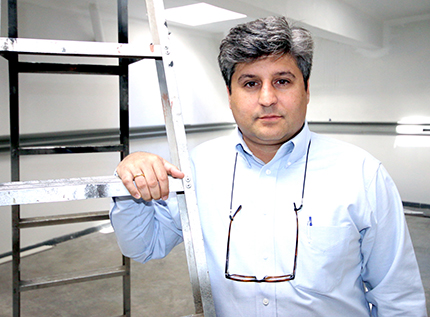
Johannesburg – Headquartered at the University of Witwatersland, Johannesburg, Director Bruce Melado, the Corider Particle Physics Institute (ICPP), has been named one of the world's most prestigious ODESS 2025 Award recipients by the Pierre Fabre Foundation in France.
This highly selective competition received a record 350 applications from around the world.
The award recognizes the achievement of the technology transfer of the SA Khan program, adapting methods from experimental particle physics to broader applications.
The winning project will integrate environmental sensors, IoT communications and real-time AI-equipped analytics. This is an approach inspired by the way CERN detectors collect, transmit and analyze data in real time.
For the first time, this integration is implemented in a cost-effective way, enabling large-scale deployments in a variety of environments.
The system can monitor air quality and associated risks in real time and support timely responses.
At the core of the project is AI_R Technology, an integrated platform that links data with advanced AI algorithms to detect potential anomalies early and assesses the impact of environmental factors and climate change.
AI_R combines cost-effective, high-precision sensors with cloud-based analytics to provide a scalable solution that can adapt to a variety of local contexts while maintaining high performance.
The project was made possible through support from the South African Department of Science and Technology (DSTI), the National Research Foundation (NRF), the Isalator-Based Science Institute (NRF-Athemba Labs), the Centre for International Development Research in Canada (IDRC), the UK Foreign, Commonwealth and Development Office (FCDO), and Cern's IdeasQuare.
Professor Bruce Melado, director of ICPP, said: “The award demonstrates how the expertise and techniques developed in experimental particle physics can be applied far beyond the laboratory. The same principles that allow basic particles to be detected help address social challenges.”
“The ability of a system to combine environmental and health data in real time provides actionable information for decision-making, particularly in resource-limited contexts,” said Professor Mary Kawonga, project lead in public health.
“We are pleased to announce that we are committed to providing a range of services to our customers,” said Chaitali Sinha, senior program specialist at Canadian IDRC.
“This achievement, as part of the initiatives of the IDRC and the UK Foreign Federation and Development Authority, demonstrates how South African leadership and innovation can leverage the power of AI in ways that are rooted in regional realities and have real-world impact.”
The award will be officially announced on October 9, 2025 at the 9th Odes International Conference in Rabaul, France.
