
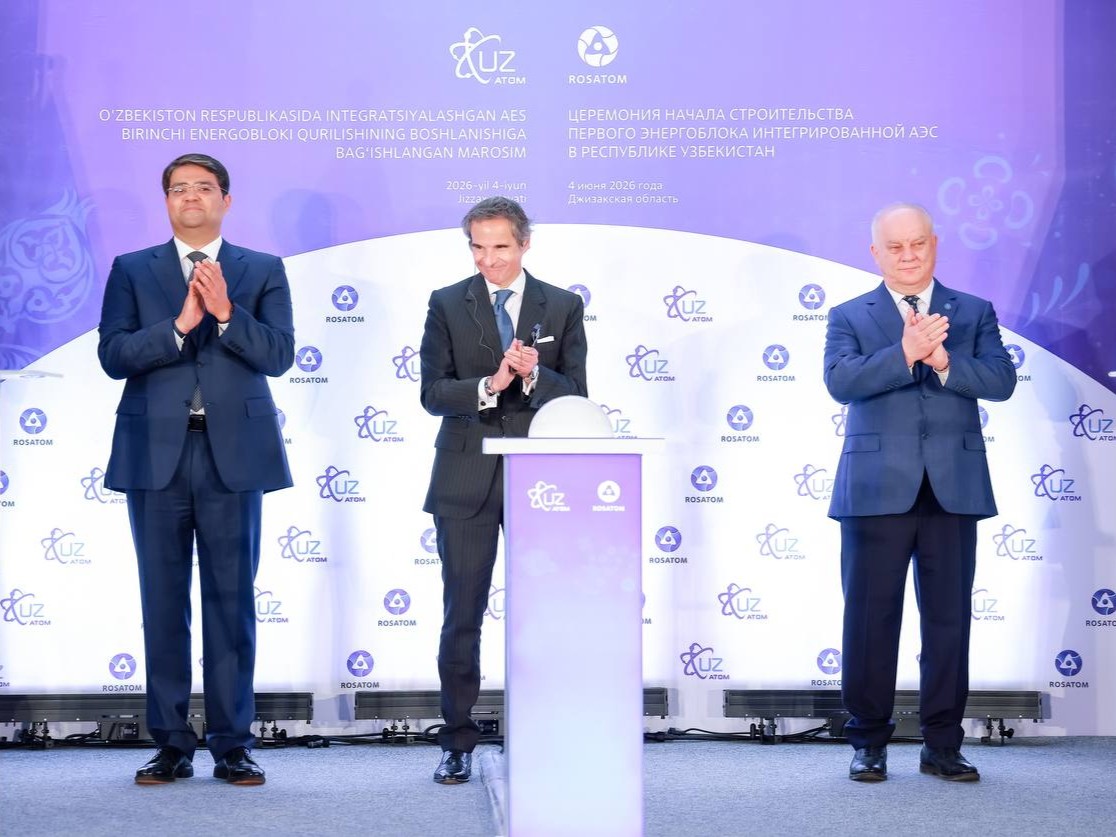
MOSCOW – Earlier this month, on June 4, 2026, a ceremony was held to mark the start of construction of the first generating unit of an integrated nuclear power plant (NPP) at a construction site in Farish district, Jizakh Oblast, Uzbekistan.
The ceremony marked the pouring of the first concrete into the foundation slab of the future small modular units within the integrated nuclear power plant project.
The ceremony was held via a live video link between the nuclear power plant construction site in Uzbekistan and St. Petersburg, where President of the Russian Federation Vladimir Putin and President of the Republic of Uzbekistan Shavkat Mirziyoyev approved the start of construction of the first generating unit of the integrated nuclear power plant.
International Atomic Energy Agency (IAEA) Director-General Rafael Grossi gave a welcome address to the attendees.
The progress of the project was reported by Andrei Petrov, First Deputy Director General of Rosatom Nuclear Affairs and President of JSC Atomstroy Export, and Azim Ahmedkadyaev, Head of the Atomic Energy Agency under the Cabinet of Ministers of the Republic of Uzbekistan (Uzatom).
“Uzbekistan is embarking on a path of accelerated high-tech development, and it is a great honor for Rosatom to be able to participate in this historic process,” stressed Andrei Petrov, Rosatom's First Deputy Director-General for Nuclear Energy.
“Together with our partners, we are only at the early stages of implementing the project, but its importance is already clear.
“Once operational, the nuclear power plant will be able to supply up to 14% of the country's electricity needs.
“This will provide a strong boost to industrial, technological and economic development.”
Petrov added: “Moreover, the nuclear city project we have proposed for Uzbekistan will create a completely new community.
“What will grow around the nuclear power plant will not be just a satellite city, but a true scientific city showcasing advanced nuclear power and related technologies.”
Just a few days ago, on the sidelines of the St. Petersburg International Economic Forum (SPIEF), participants discussed the outlook for nuclear power development, including SMR projects and human resource development for new countries.
Speaking at SPIEF, Rosatom Director General Alexei Likhachev outlined three key challenges facing such projects.
“We have three main tasks: to build our own nuclear power plant, to strengthen and establish the nuclear industry in Uzbekistan, and to foster a social environment,” said Alexei Likhachev.
The “first concrete” poured into the reactor building's foundation marks the facility's transition to under-construction status according to IAEA standards.
This milestone marks the beginning of an important stage in the implementation of Uzbekistan's integrated nuclear power project and represents the logical continuation of the long-standing cooperation between Russia and Uzbekistan in nuclear technology.
As part of the 'first concrete' stage, experts will pour 133 cubic meters of concrete mix, bringing the total amount of concrete required for the project to 10,000 cubic meters.
The successful start of construction of Uzbekistan's first integrated SMR also has implications for South Africa, which operates the Koeberg Nuclear Power Plant, the only nuclear power plant on the African continent.
At the same time, another large-scale project is already being implemented on the continent: the construction of Egypt's El Dabaa nuclear power plant.
All four 3rd generation + VVER-1200 units are being built simultaneously, making Eldabaa the largest nuclear construction project in Africa. The project employs more than 30,000 people.
In parallel with the development of nuclear power in Egypt, Rosatom continues to deepen its cooperation with South Africa.
The two countries maintain a long-standing partnership in the nuclear field. In 2024, Rosatom and South African energy company Eskom signed an action plan for 2024-2026 that includes workforce development and joint education initiatives.
To further strengthen this cooperation, a Memorandum of Understanding was signed in 2026 with the state-run Nuclear Energy Authority of South Africa (Necsa) for skills development and knowledge exchange in nuclear power and related technologies, with a particular focus on supporting women and young professionals.
Under the agreement, Rosatom will provide an additional 15 scholarships for South African students to study at leading Russian universities.
