

By lethabo mkhize
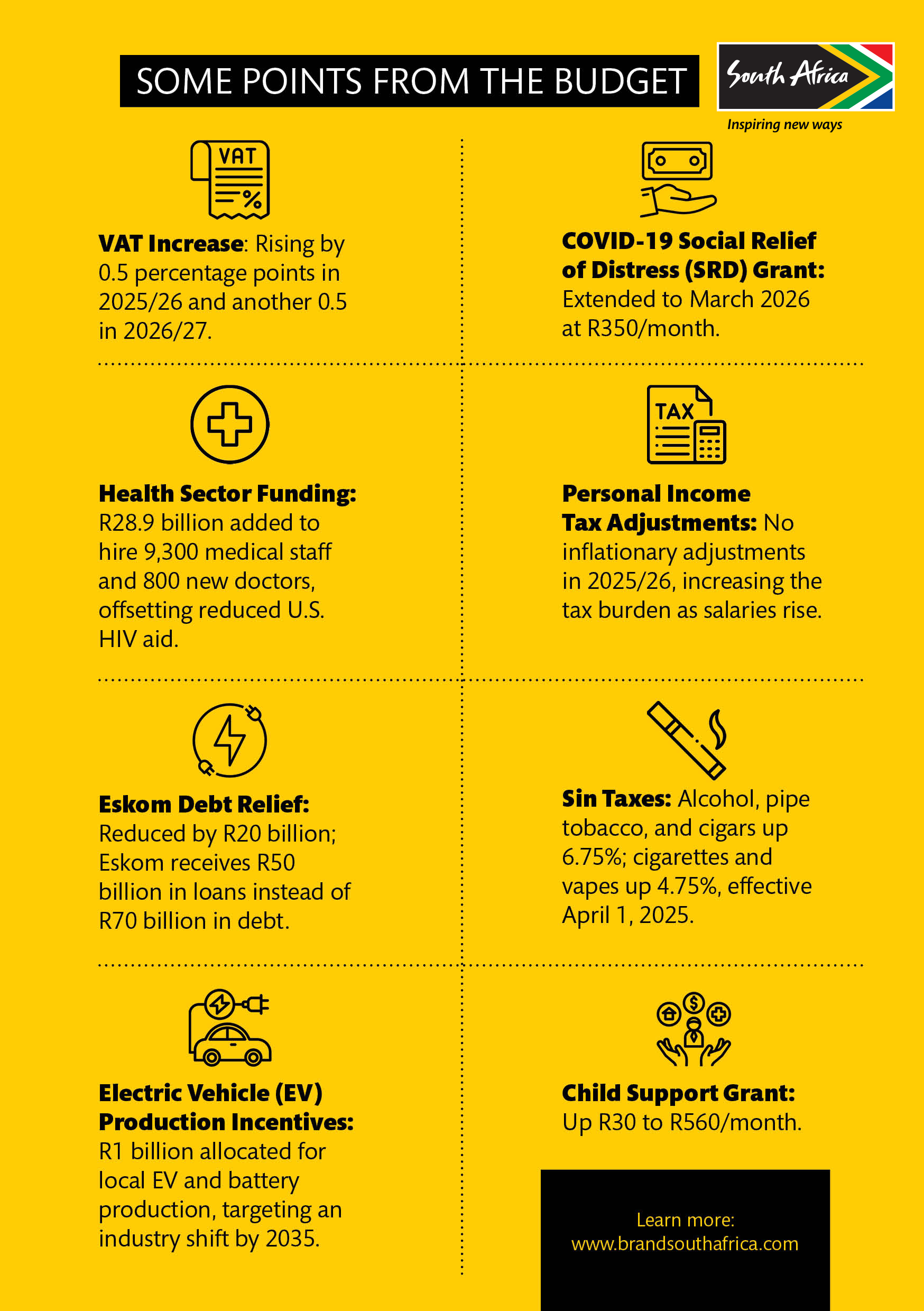
The South African Budget Speech 2025/26, submitted by the Minister of Finance on March 12, 2025, outlines the financial roadmap for the country amidst economic challenges and ongoing financial constraints. With a total government spending of R2.59 trillion, the budget aims to address rising debt and financing constraints while balancing economic recovery, social welfare and infrastructure development.
Major budget allocation for 2025/26
Government spending is divided into key areas, with the largest allocated to social services, economic development, peace and security and public services. A detailed breakdown is as follows:
Social Services – R1.52 trillion
Social Services constitutes the largest share of budgets focused on education, healthcare, community development and social grants.
Education and Learning – R508.7 billion
The education sector remains a top funding priority in the budget, receiving R508.7 billion. Basic education alone accounts for R33.23 billion, ensuring continuous investment in schools, teacher salaries and study materials. Additionally, the National Student Financial Aid Scheme (NSFAS) receives R55.4 billion, supporting university students from disadvantaged backgrounds. Other allocations include university relocation (R4.84 billion), skill development (R27.9 billion), and technical and vocational education (R14.2 billion).
Healthcare – R298.9 billion
South Africa's public health system is a key focus area, receiving R298.9 billion. This includes District Health Services (R13.21 billion), Central Hospital Services (R58.3 billion), and State Hospital Services (R49 billion). Additional funding will be directed towards other health services (R47.5 billion) and hospital maintenance (R11.9 billion) and reflects the government's efforts to strengthen health infrastructure.
Community Development – R2866 billion
Municipalities and urban development will receive R286.6 billion aimed at improving public transport (R67.7 billion), human settlements (R58 billion), and city infrastructure (R54.8 billion). The municipality's fair equity program is R106.1 billion, securing direct funding for local governments to enhance service delivery.
Social Development – R42.23 billion
South Africa's social welfare system continues to expand, with R42.23 billion allocated to grants and social assistance. The older age grant receives R117.4 billion, while the child-supported grant accounts for R90.4 billion. Other Social Security Funds, including disability and foster care grants, totalling R9.5 billion, indicating their commitment to supporting vulnerable citizens.
Economic Development – R28.98 billion
To stimulate economic growth and job creation, the government has allocated R289.8 billion to various development initiatives. Infrastructure and economic regulations will receive R175.7 billion, followed by R40.8 billion industrialization and exports. Supporting Agriculture and Rural Development (R29.4 billion) and Job Creation Initiative (R23.7 billion) highlight the importance of sustainable employment opportunities. The Science, Technology and Innovation Program is funded at R200 billion, ensuring future investments in industries.
Peace and Security – R266.1 billion
Safety and security remain priorities, with R266.1 billion being directed towards law enforcement, defense and public safety. Police services are R13.34 billion, defense budget is R60.8 billion, and courts and prisons are funded at R58.1 billion. The Home Affairs receives R13.9 billion to strengthen immigration management and identity documentation systems.
General Public Services – R78.7 billion
Government functions, legislative operations and management of diplomatic relations will receive R78.7 billion. This includes administrative and fiscal issues (R51.7 billion), enforcement and legislative bodies (R17.8 billion), and diplomacy (R9.1 billion).
9. Debt Service Costs – R424.9 billion
One of the most important concerns in the budget is the debt service cost of R424.9 billion, reflecting the government's struggle against managing rising public debt. The allocation highlights the burden of loan repayments in South Africa's financial position.
10. Emergency Reserve – R5 billion
Due to the unexpected financial shock, R5 billion in emergency reserves are set aside to ensure the government can respond to emergencies without disrupting core services.
Important takeouts from budget speeches 2025/26
Increased spending on social welfare and grants
The budget strengthens the government's commitment to social support, along with a significant increase in education, healthcare and social development funding. Grants for the elderly, children and unemployed remain important areas of focus. Social grants will receive R42.23 billion, including:
Old-fashioned grants – increased to R2,320 per month (previously: R2,190). For recipients over the age of 75, the grant is currently R2,340 (previously: R2,210). Disability grants – increased to R2,320 per month (previously: R2,190). War Veterans Grant – Increased to R2,340 per month (previously: R2,210). Care Dependent Subsidies – Increased to R2,320 per month (previously: R2,190). Foster Child Grant – Increased to R1,250 per month (previously: R1,180). Child Support Subsidy – Increased to R560 per month (previously: R530). Grant-in-Aid – Increased to R560 per month (previously: R530). Social Relief of Pain (SRD) Grant – Monthly R370 for increased debt service costs
At R424.9 billion, South Africa's debt repayment remains a major financial concern. This high cost limits the government's ability to invest in infrastructure and job creation initiatives.
Education and skills development as a priority
Over R500 billion allocated to learning and culture, governments prioritize education, youth skills development and access to higher education through NSFAS funding and university support.
Focused on job creation and industrialization
The allocation of R289.8 billion to economic development suggests efforts to boost job creation, stimulate exports and support innovation-driven growth. Key areas include agriculture, industrialization and infrastructure development.
Continuous investment in healthcare
Despite the financial challenges, the government is increasing funding for hospitals and primary healthcare services, improving access to healthcare across the country.
Possibility of increased VAT
To fund the growing budget, the treasury is considering raising VAT by 0.5% in 2025, bringing another potential increase in 2026 to 15.5%.
The 2025/26 budget reflects the balance between social support and economic sustainability. While increased spending on education, healthcare and infrastructure is positive, rising debt services costs and potential tax increases remain concerns. Governments face the challenge of ensuring financial responsibility while promoting economic growth and job creation.
As key focus areas of education and social grants, budgets are consistent with South Africa's commitment to reducing inequality and improving livelihoods. However, long-term economic stability depends on managing debt, increasing revenues, and creating sustainable employment opportunities.
https://www.youtube.com/watch?v=horoac9uksw
South Africa 2025/26 Budget Speech
What is the total budget for South Africa for 2025/26?
The total integrated government expenditure for fiscal year 2025/26 was R2.59 trillion.
What is the biggest spending area in your 2025 budget?
The biggest budget allocations are:
Learning and Culture (Education): 50.87 billion Social Development (Grants and Welfare): 42.23 billion Health Services: R298.9 billion Community Development (Infrastructure and Housing): R286.666 billion Economic Development (Employment Creation and Innovation): R28.98 billion
Will South Africa increase VAT in 2025?
Yes, the National Treasury expects a VAT increase of 0.5% (15.5%) in 2025, with an additional 0.5% increase in 2026 (16%).
How much does South Africa spend on debt repayment?
Debt service costs are R424.9 billion, which is one of the highest allocations in the budget.
How much will you allocate to education?
R508.7 billion has been allocated for education, NSFA, university, skills development, education
What is the government doing to help create jobs?
The budget includes R289.8 billion for economic development focused on industrialization, agriculture and innovation to promote job creation.
How much is allocated for healthcare?
South Africa's health care sector receives R298.9 billion covering hospitals, district health services and medical infrastructure.
What is the emergency reserve for?
An unexpected emergency and financial shock have secured a R5 billion emergency reserve.
